_Emergency Plug
Quickly create a safe working environment for first responders working on any type of Full and Hybrid Electric Vehicles.

The latest generation Emergency Plug® automatically detects whether the vehicle registers that the battery pack temperature is becoming too high, in accordance with the IEC 61851-1 standard. As soon as the Emergency Plug® detects this, it gives a clear visual warning: a red flashing signal next to the blue LED indicator. This allows you to see at a glance whether there is an increased risk.
WE INCREASE SAFETY:
Through information
Through early warning
For first responders and emergency services
HOW IT WORKS
The temperature of the battery pack has a direct impact on the performance and safety of electric vehicles. If the temperature gets too high, it can lead to a shorter lifespan, damage or even dangerous situations, such as thermal runaway and thermal propagation. The updated Emergency Plug® now offers a smart solution to detect these risks at an early stage.
IMAGINE THIS….
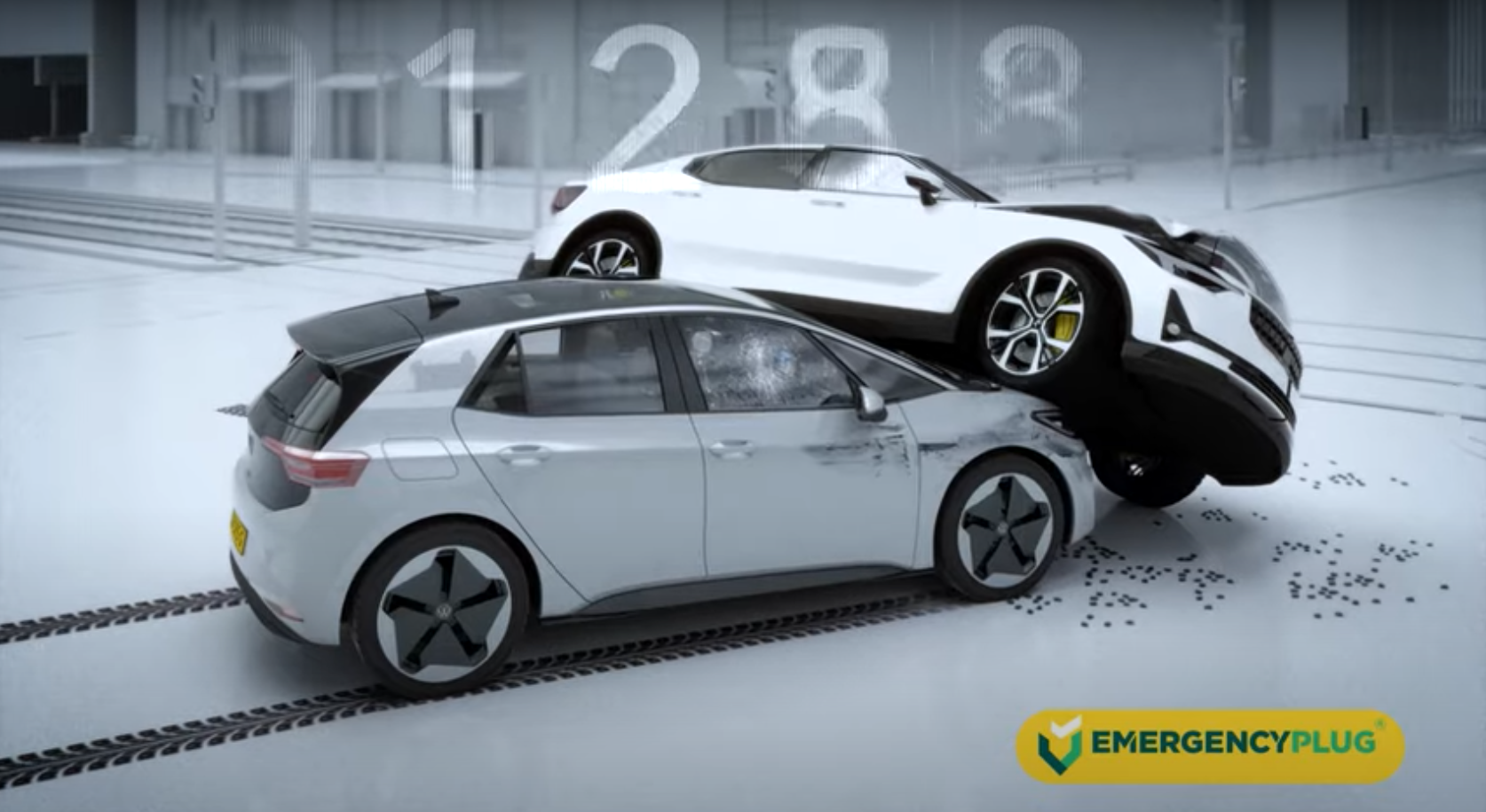
An electric vehicle is involved in an accident and the automatic gearbox is still in Drive (D) or Reverse (R). A first responder won’t know if the EV is still switched-on. And the driver could still step on the accelerator and set the car in motion. Result: the EV could drive off without any warning. The effects could be devastating…
SAVING TIME…
It takes a lot of time to create a safe working environment including disabling the Electric Vehicle. Using the Emergency Plug® (Plug) this can be reduced to seconds.
The Emergency Plug® has been developed to prevent unpredictable vehicle movement by any Full or Hybrid Electric Vehicles (EVs) in an emergency situation as well as during regular maintenance.
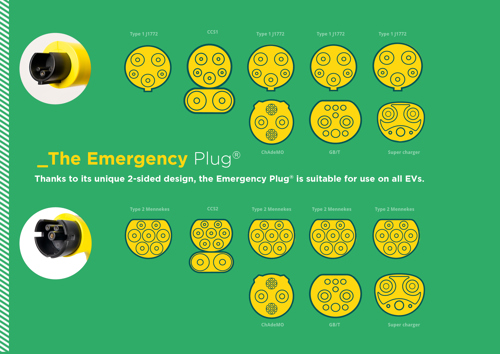
Even though every Emergency Plug® requires different signals, our Emergency Plug® simulates the different charging protocols of each EV, we are able to guarantee the Emergency Plug®’s suitability for 100% of all EVs that comply with the safety protocols of the UN ECE R100 regulation. By providing continuous visual feedback from the Emergency Plug® about whether the EV is still able to drive away or not, we can ensure the safety of users throughout the emergency situation or during the entire maintenance procedure. Quickly creating and maintaining a safe working environment.

ANNUAL SAFETY SERVICE
Our local distributor can provide an annual service, carrying out several tests and calibration. Alternatively, the Emergency Plug® Service Kit enables you to carry out your own service via our Plug portal.
FREE FIRMWARE UPDATES AND EXTRA WARRANTY
After registering your Emergency Plug® on the service portal of our website, you will receive an extra year’s warranty, giving a total of two years. This includes the possibility to update new firmware for free, if needed. Ensuring you can use your Emergency lug® for many years to come.
OPTIMAL RELIABILITY IN EMERGENCY SITUATIONS
The Total Safety Solutions' Service Kit guarantees that the Emergency Plug® is always ready to save lives. While the built-in self-test is just the initial step, the Service Kit’s in-depth checks and updates take reliability and safety to the next level.
When every second counts – especially in electric vehicle incidents – it is crucial for the Emergency Plug® to function flawlessly. The Service Kit delivers that confidence, acting as an all-in-one solution for monitoring, reporting, and forward-thinking maintenance.

The Emergency Plug® does not detect thermal runaway and does not directly measure the battery temperature. The plug reads via the vehicle communication system when the car itself detects an excessively high battery temperature and issues a warning.
The red flashing light is activated when the vehicle itself indicates that the battery temperature is too high. The exact temperature at which this occurs varies per car brand and model, as each manufacturer applies its own limit values due to the diversity of batteries, each of which has its own limit value.
When the red light flashes, it means that the vehicle is reporting an excessively high battery temperature. Normally, the car cools the battery pack. Depending on the situation, take preventive measures in case the car can no longer handle this cooling due to physical damage to the car and/or battery pack.
This depends on the type and hardware version of your current plug. Serial numbers starting with 2211xxxx and higher are suitable for the upgrade. If in doubt, please contact your supplier or Total Safety Solutions to check whether your Emergency Plug® can be upgraded with new software or whether replacement is necessary.
This means that the vehicle is no longer issuing a warning and that the battery temperature is back within safe limits according to the vehicle. Blue light indicates normal operation with no active warnings.
A red flashing signal indicates that the vehicle has detected an excessively high battery temperature; in the event of an accident, it is therefore important to be extra alert to smoke, odours or heat.
No. The Emergency Plug® does not switch off the high voltage and main power, i.e. it does not ‘isolate’ the EV. This means all the electric options, such as windows, seats and lights of the EV can still be used.
Not always. The R100 regulations oblige an EV manufacturer to ensure that the EV will not drive away under its own propulsion. Each EV manufacturer is free to find a suitable solution to prevent this from happening.
Not always. The R100 regulations oblige an EV manufacturer to ensure that the EV will not drive away under its own propulsion. Each EV manufacturer is free to find a suitable solution to prevent this from happening.
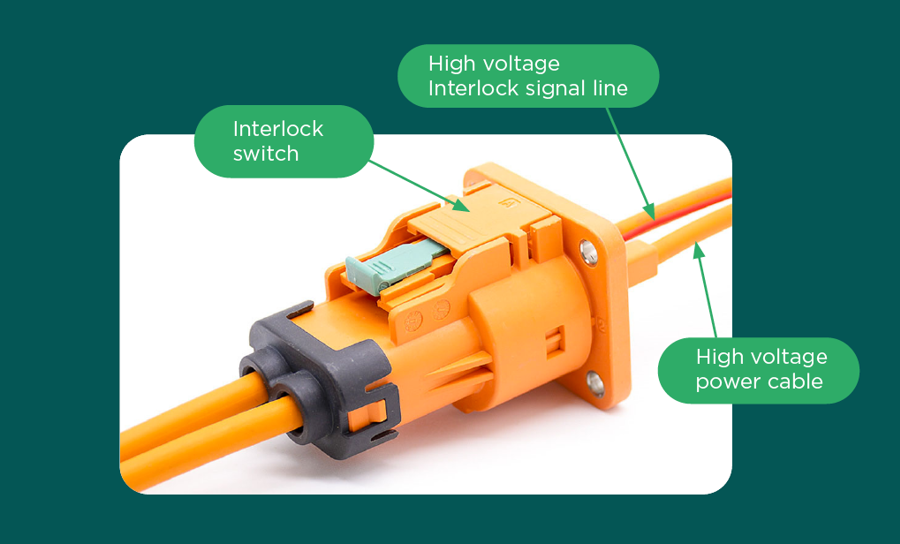
An interlock (HVIL) is a safety feature of EVs that protects individuals during the assembly, repair, maintenance and operation of an EV as well as in the event of an accident. This includes when the airbags have been deployed, or if the first responder loop has been cut.
However, even when the HVIL should have been deployed, it cannot always be relied upon it. The reasons for this are:
The Proximity Pilot (PP) pin on Plug Type 2 tells the EV the type of cable that is connected to the socket – different cable thicknesses can cope with different amounts of electrical current. On Type 1 it can be used to indicate that the plugs will be removed shortly.
The Control Pilot (CP) pin provides bi-directional communications between the EV and the charging system. This checks the maximum amount of current that the EV is able to take at any one time.
The Plug recognises and communicates the desired PP and CP signal to activate the EV’s safety protocol. This is different for each EV.
“If a battery can be externally charged by the user, vehicle movement by its own propulsion system shall be impossible as long as the connector of the external electric power supply is physically connected to the vehicle inlet”
The Automotive industry has developed several types of safety solutions in response to the R100 regulations. The Emergency Plug® is capable of activating each safety protocol, ensuring the safety of first responders. Some EVs may activate their safety protocol when a standard charging plug is inserted. However, the user has no continuous visual confirmation of this. Moreover, this type of activation is mainly used in older EV types and is becoming less common.
There are two types of plugs. Download the datasheet of the Emergency Plug® which was developed according to European guidelines here.
There are two types of plugs. Download the datasheet of the Emergency Plug® developed for the USA here.
Kuwait
Nehad Mohammad AlHaj Ali
Netherlands
Sales
Philippines
Dennis Renato Purificacion
Chile
Mario Ramirez
Belgium
Sales
France
Laurent Halgand / Michael Loucaridis
Italy
Ferrari Zanlucchi Georg
Australia
Greg Bellairs
Belgium
Guido Deschacht
Brazil
Letícia Laborê
Canada
Tarrant
China
Ms. Lisa Cao
Colombia
General contact
Cyprus
Demetris Demetriou
Czechia
Slovakia
ContactLuboš Ralík
Denmark
GKV Brandmateriel Aps
Estonia
Toomas Villo
Finland
Oy Veljekset Kulmala Ab
Germany
Florian Muchow
Greece
Timos Vossos
Hong Kong
Randy Hau
Hungary
Attila Krátky
Iceland
Sverrir E. Bergmann
United States of America
Chris Hurst
India
Vikram Shergill
Indonesia
Wiyono Minarno
Ireland
Michael Howard Jnr
Israel
Sharon de Beer
Italy
Japan
Koh Urakawa
Malaysia
Fabian Wee
New Zealand
Stuart Coulton
Norway
Stein Asgeir Egenes
Poland
Marek Lasek
Portugal
Renato Marques
Romania
Dragos Vasai
Saudi Arabia
Baraa Adi
Singapore
John Ong
Slovenia
Gaber Mezan
Korea, Republic of
Eunyoung Ji
Spain
Carol Huber
Sweden
Marcus Bergsjö
Taiwan, Province of China
Johnson Peng
Thailand
Prachya Jongsirirattanaphan
Netherlands
Jan Wijnans
Türkiye
Berk Başdoğan
United Arab Emirates
Gilles Klein
United Kingdom of Great Britain and Northern Ireland
Stephen McAllister
United States of America
Ryan Darley
United States of America
Jason Stallings